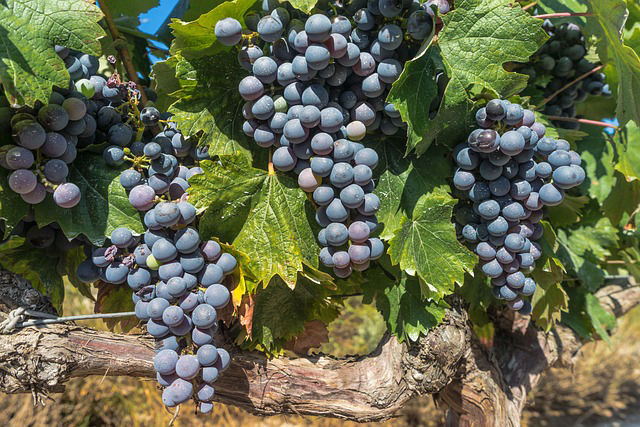
The Organic
Maison Bertrand Giraud has wanted for several years to develop its wines towards organic wines.
This desire is motivated by several reasons because after an edifying observation for decades, that we eat organic but that drinking organic still remains very marginal.
ORGANIC WINE (BIO) :
Regulated appellation. Wine resulting from a mode of culture excluding the use of pesticides, but also of chemical fertilizers. Copper replaces chemical treatments in the vineyard. Additives are authorized in the cellar for the vinification (including: addition of tannins, acidifier, wood chips and exogenous yeasts that accelerate the fermentation).
This appellation is very controlled and requires a whole process before having this label "AB".
Maison Giraud will work within the next 3 years to have most of the vineyards "BIO" and thus apply the 3 reasons for this motivation:
Reason N°1 : For the environment
The life cycle of synthetic pesticides is long. Derived from petroleum, they are sprayed on the vines at different stages of the crop. Rainfall carries the residues of these pesticides with it into the waterways. The water cycle includes not only the marine life that ingests these chemicals, but also us humans, who drink water that is far from pure.
"Watercourses, more vulnerable because directly exposed, are more marked by this pollution with 53% of the national area exceeding the concentration of 0.1 μg/l, the "drinking water" standard for a subs- tance. Surface contamination takes, for many parts of the territory, several years before being visible in groundwater; thus, in 2014, 31% of the groundwater territory exceeds the "drinking water" standard for a pesticide." All these products are also suspected of being responsible for the rarefaction of bees, birds, in a word, the decline in biodiversity. France is the first European consumer of pesticides and as we discovered in 2016.
Reason N°2 : For our health and for the health of wine growers
The French wine sector for the pesticide industry represents 20% of the agricultural market. In other words, 20% of the pesticides used in France by farmers go into the cultivation of vines.
When these chemical aids appeared after the war, it was to fight against diseases to increase yields and feed the population. The authorized volumes per hectare have gradually decreased, winegrowers have been called to vigilance, even to the point of wearing protective outfits and masks when they spray in the vineyards.
In 2013, Inserm published an analysis study on pesticide exposure and the occurrence of pathologies that details according to the types of population and exposure, which diseases are most often encountered. Choosing wines grown without pesticides is therefore supporting our choice not to use probable carcinogenic products in their daily lives.
Reason N°3 : For the taste of the wine
After study, biodynamic and natural wines are the best. In fact, only these two production methods free the grapes from the constraints of chemical inputs in the vineyard (also in organic) and from additives in the winemaking process.
"The first big difference between biodynamic and traditional is in the vineyard. The number one goal of biodynamic viticulture is to have a living soil, healthy grapes, vines whose roots go down deep to draw the best minerals. Traditional viticulture uses pesticides and insecticides that will trap the aromas of the wines.
The result is wines that are all alike, with less organoleptic qualities, less expression, less freshness and elegance in the mouth...".
"In biodynamic viticulture, the winegrower works a living and healthy soil, the grapes are of better quality, so they can make better wines. We find aromas that we had not had for several decades ".